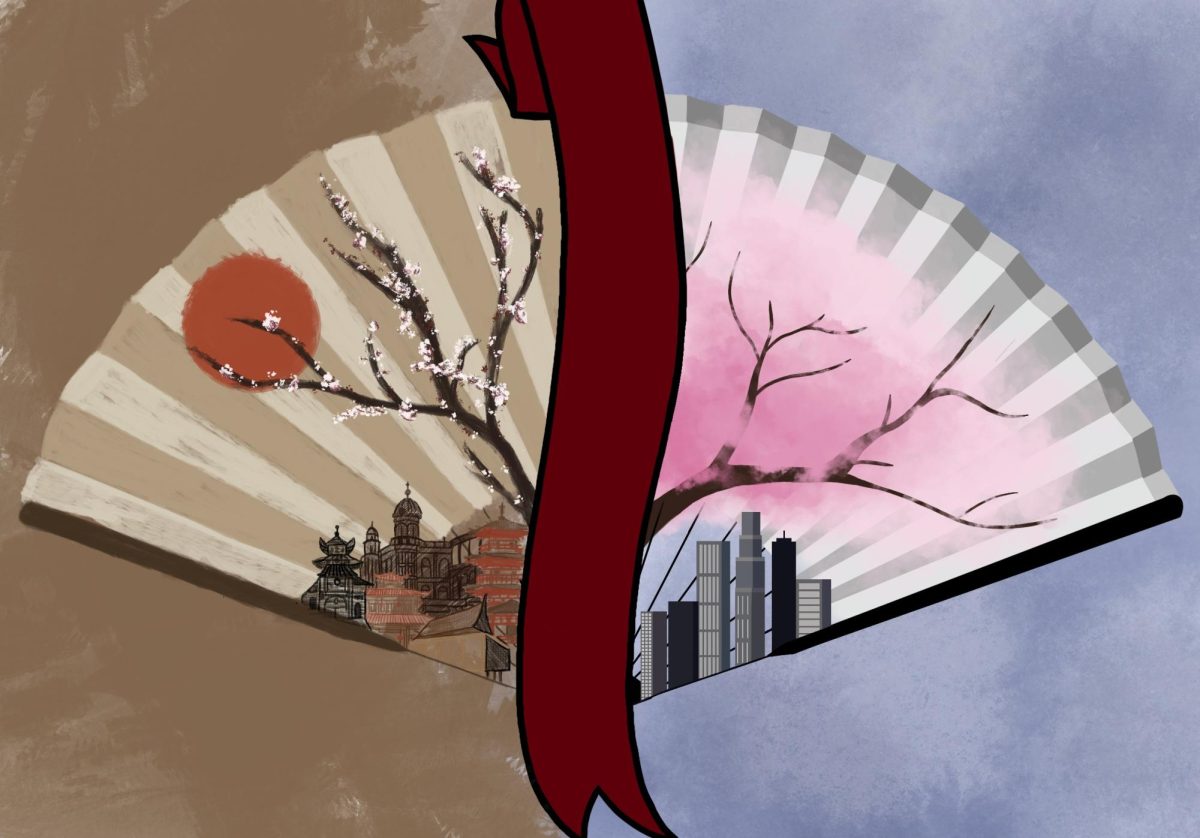

Firecrackers, red packets, new clothes, clean homes and round tables crowded with traditional dishes: this is Lunar New Year, a joyous celebration for some, a typical Tuesday for others.
Marking a fresh start for 2026, the 15-day-long celebration begins on Feb. 17, bidding farewell to the Year of the Snake and welcoming in the Year of the Horse. Throughout the time of cheer, ancient and cultural traditions bloom across both Asia and Asian diaspora communities in the West. With varying practices and beliefs, Lunar New Year, known as 春节 (chūn jié) in Chinese, Tết Nguyên Đán in Vietnamese, or 설날 (seollal) in Korean, brings joy, hope and new beginnings.
The Myths that Shaped Lunar New Year
According to Chinese legend, the origin of the Lunar New Year begins with a story about a monster: Nián. Long ago, this monster terrorized towns on Lunar New Year’s Eve, eating the villagers and their livestock. People began looking for a way to destroy it, leading them to set off firecrackers and wear and decorate their houses with the color red. The loud sounds and bright colors scared Nián away, and the Lunar New Year’s Eve traditions continue to this day.
Another element of the Lunar New Year is the myth of the zodiacs. With each new year, a new zodiac takes the reins. Long ago, the Jade Emperor hosted a race for 12 animals: the rat, ox, tiger, rabbit, dragon, snake, horse, goat, monkey, rooster, dog and boar. The order in which the animals arrived at the finish line of the race would determine their order in the zodiacs. As the animals neared the finish line, the ox was in the lead, but as it was crossing the river, the rat hopped on its back and ended up arriving first, making it the first zodiac animal, followed by the ox and tiger.
Traditions and Rituals
Today, many traditions surround the holiday, ranging from nationwide celebrations to activities specific to individual families. For many students at Foothill Technology High School (Foothill Tech), these Lunar New Year traditions give the holiday depth and meaning.
“We usually make bánh tét, it’s a banana leaf [and] rice cake kind of thing … Sometimes we go dress shopping for áo dài, the traditional dress for Vietnam … Typically you would wear red, but nowadays you can go with any color, usually pastels. I spend time with my family, and we kind of just have fun together, like a party,” Sabrina Nguyen ‘28 said.
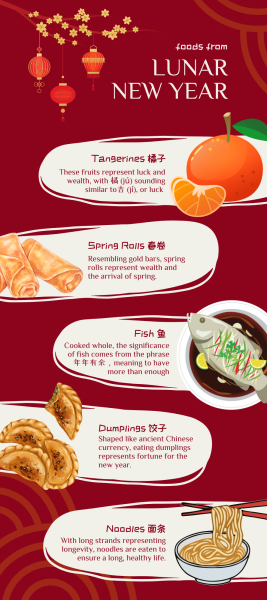
Traditionally, on Lunar New Year’s Eve, families will hold a large feast to bring families together, representing unity, abundance and prosperity for the new year. Many classic dishes eaten on Lunar New Year’s Eve are chosen as a result of homophones, including noodles for longevity, fish for abundance, dumplings for wealth, rice cakes for prosperity, spring rolls for opulence and citrus fruits for luck.
How Lunar New Year is Transposed in Ventura
For diaspora families, celebration may look different from the traditions of their home country. While Lunar New Year often entails grandiose festivities in countries across Asia, in the West, it isn’t quite as widely celebrated.
“[In Vietnam] the whole country celebrates it, so it’s definitely more festive there, whereas here, it’s only small parts, especially in Little Saigon down in Anaheim on Bolsa Avenue … There, they celebrate it way more and they have more cultural aspects of it, but in places where Asian populations aren’t too big, you don’t really see it much,” Nguyen said.
Many students at Foothill Tech commented on the lack of celebration in the Ventura County area, mentioning how larger cities with higher Asian American populations, such as Los Angeles, offer more festivities.
“It’s definitely harder to celebrate … My parents have to travel an hour or two down to LA to even see a bit of it,” Brandon Chang ‘26 said.
“It’s different because I have to travel a little bit to LA to get more authentic stuff where immigrants already settle, like Chinatown, but it is nice being here, seeing the cultural difference,” Hansen Chen ‘27 added.
To some, residing in the United States changes how they celebrate Lunar New Year, especially in places like Ventura, Calif., where Asian diaspora communities aren’t too prevalent. In Ventura County, only about eight percent of residents identify as Asian, a significantly smaller percentage than the state of California overall, which sits at roughly 18 percent Asian.
“I really just follow what my family does … We follow what my grandparents did, and then after that, my parents did, and I follow in my parents’ footsteps,” Ryan Phan ‘28 said.
Tyler Tran ‘28, who no longer celebrates Lunar New Year, mentioned the geographic gap as a factor in his family’s decision to discontinue the festivities.
“[We stopped celebrating] just out of convenience. Our extended family lives in LA, and there are real connections to Chinese culture [there], so over here we feel a little bit disconnected from that,” Tran said.
As of February 2026, the United States does not recognize the Lunar New Year as an official federal holiday. However, certain states, such as California, Colorado and New Jersey, have declared it as an official holiday, with California’s Assembly Bill No. 2596 officially allowing state employees to take time off to celebrate. Furthermore, the state of Washington has declared it a legislatively recognized holiday, and in the state of New York, it is a public school holiday.
Whether in Asia or overseas, the Lunar New Year provides connections and culture for people worldwide. Although the holiday may not be as widely celebrated in Ventura County and the United States as in East and Southeast Asia, festivities are still found in a variety of places, whether they’re grand, large-scale events or simply individual family dinners from the comfort of home.