This account of a student at Foothill Technology High School (Foothill Tech) regarding Artificial Intelligence (AI) usage was given under the condition of anonymity.
“Honestly, even if I use AI to cheat and do the homework, I still feel like I earned that A. I don’t care what anyone says … I earned it because if you put me in a room with just equations and the problems, I can solve them without the help of AI,” an anonymous student at Foothill Technology High School said.
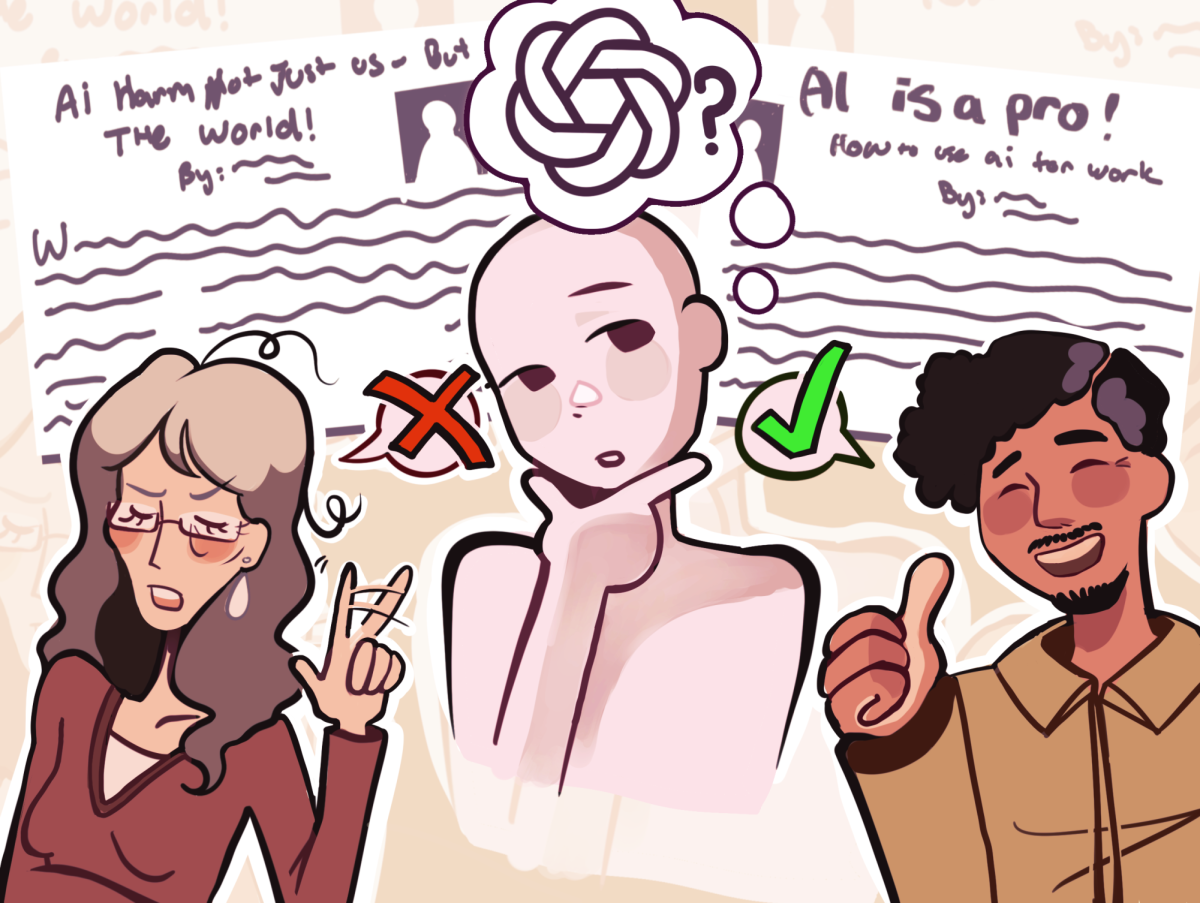
Students today are constantly getting bombarded with conflicting information about Artificial Intelligence: this research essay says AI is hurting the environment, this article says AI will be integrated into most jobs by 2032, one teacher vehemently lectures your class to not use AI and your other teacher graded your AP essays with the tool. The reality of student AI use is complex and often stigmatized; therefore, most students hide their usage.
“Realistically, I started using [AI] in ninth grade, mostly tenth,” anonymous said.
“I use it for math — I’ll do the first problem, but the rest of the problems I’ll just use AI because I’m too lazy to do them. I know how to do it, [but] why waste my time working on something I know how to do?” anonymous said.
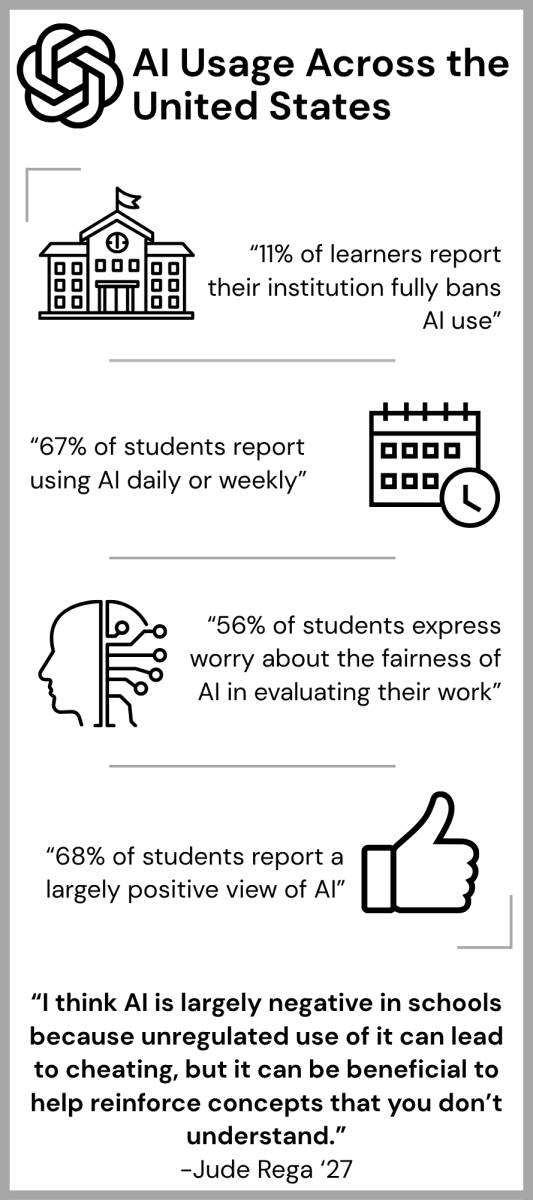
Anonymous now mainly uses AI for math. Since their sophomore year, their morals regarding the extent to which they use AI have shifted.
“The reason I stopped using AI as much is that this year I’m taking AP classes. Eventually I have to take the AP tests with no help, so I feel like I actually have to know the material,” anonymous said.
The line anonymous absolutely won’t cross is using AI in the class they are passionate about.
“I’ll spend a lot of time on my APUSH (Advanced Placement United States History) homework [and] sometimes AP Lang (Advanced Placement English Language and Composition), but in my Microbiology class … there’s no cheating — I don’t want to cheat because that’s a major I’m actually interested in,” anonymous said.
“The computational power required to train generative AI models … can demand a staggering amount of electricity, which leads to increased carbon dioxide emissions and pressures on the electric grid,” an MIT News article on Generative Artificial Intelligence’s (Gen-AI) environmental impact said.
“Beyond electricity demands, a great deal of water is needed to cool the hardware used for training, deploying, and fine-tuning generative AI models, which can strain municipal water supplies and disrupt local ecosystems,” the article said.
Most students who use AI are already aware of the effect it has on the environment. The information isn’t easy to ignore when at least once a day an Instagram Reel pops up with someone violently advocating to stop the use of AI and sign their petition. Yet even still, the benefits the tool provides make it easy to overlook the negative factors.
“I feel like AI isn’t moral or immoral. At the end of the day, it depends on the person. If you’re gonna use it to cheat on tests, that’s on you. If you’re using it to make study guides or Quizlets for classes to study on tests, I feel like that’s moral,” anonymous said.
“When it comes to environmental harm, I feel like that’s just something that happens as technology improves … but I feel like as AI gets better and better, we can find a solution,” anonymous said.
Despite that moral line anonymous draws, a discomfort surrounds sharing the extent of their AI use with others.
“I don’t really feel comfortable about telling people about my AI usage. Obviously there are people that will disapprove and snitch right away, so if you’re going to use AI too much you’ve gotta be smart about it and you can’t really tell people that you’re using it,” anonymous said.
“That [disapproval] definitely is a red flag, which is why I stopped using [AI] as much for cheating on tests specifically,” anonymous said. “But on homework, even our math teacher said you can use AI to check your answers or for help, so using it for help and using it to cheat are two different things … but sometimes the lines can get blurry.”