A poorly worded question, a solution that seems too simple, a blank answer — the doubt, a surge of confidence, a fall into confusion.
Or, an anticipated question, a formulated result, a crafted explanation — the certainty, a rush of adrenaline, a satisfaction in completion.
Students at Foothill Technology High School (Foothill Tech) may sometimes question whether or not the tests they take are truly accurate in measuring proficiency. Does one bad exam score really mean they do not have what it takes to pass a subject? If they score high on a test, will they get into their college of choice? Do students prefer teacher-made assessments over standardized ones? In 2026, testing is a principal method used to evaluate students’ progress, but there are benefits and drawbacks that come with formal assessment.

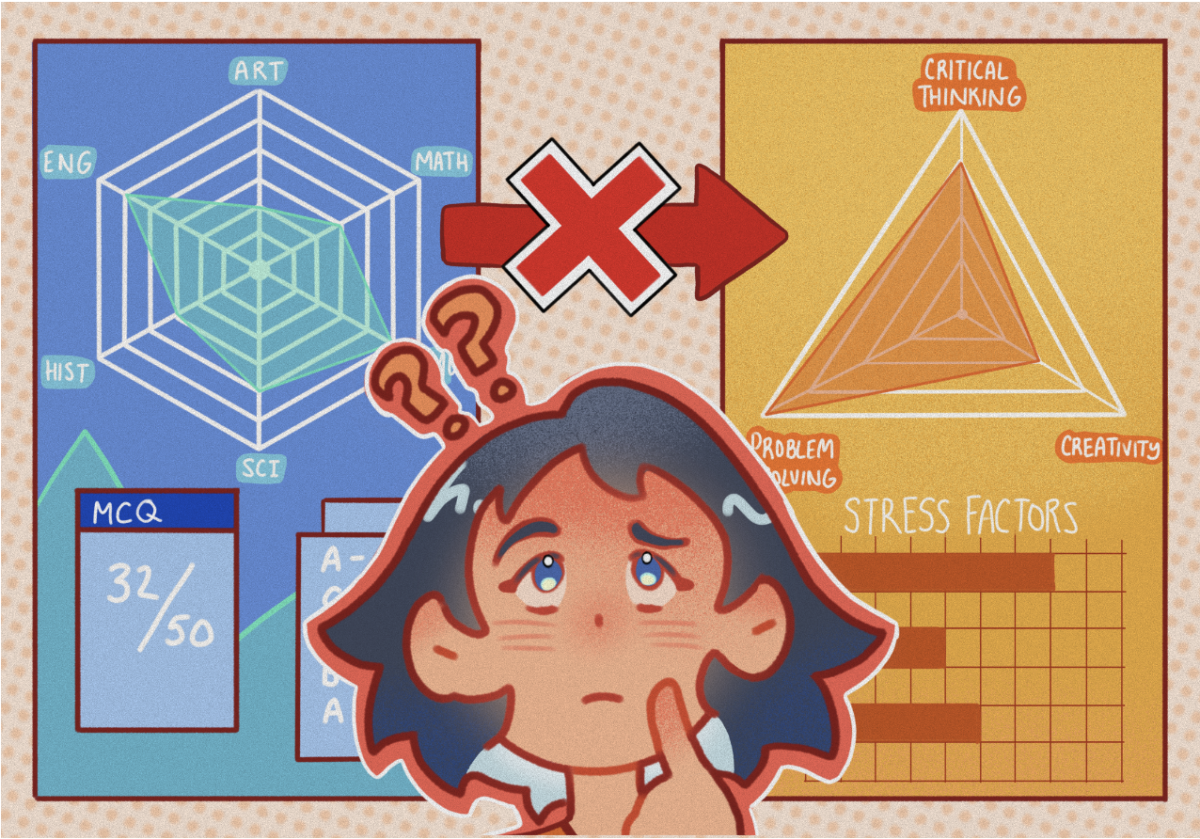
While exams can act as a report for those who formulate educational goals and implement curriculum standards, according to the Education Week Research Center (EdWeek), about 60 percent of educators do not believe that standardized tests measure the necessary skills of a student’s education. This is because standardized tests tend to solely focus on objective data, rather than creativity, critical thinking or problem solving.
This brings the question of whether students are assessed on their ability to adapt to a specific format of testing their knowledge, or if they are being evaluated on their actual understanding of the material.
Can students be held accountable through objective testing?
Being tested on a regular basis ensures that students are checked on their grasp of a topic and that they are held accountable for certain amounts of knowledge.
“Standardized testing requirements are designed to hold teachers, students and schools accountable for academic achievement and to incentivize improvement. They provide a benchmark for assessing problems and measuring progress, highlighting areas for improvement,” American University said.
Not only are students made responsible for what they have learned, but testing also provides teachers with the feedback needed to guide the course in a direction that benefits the students. Assessments can display what subject a class has nailed, or which areas need to be further explained and improved upon. Additionally, standardized tests ensure consistent grading, as there isn’t the variance that could be present through projects without a set answer, which can be graded subjectively.
Is it okay to prioritize definitive answers over critical thinking?
On the other hand, students can be led to focus on memorizing information rather than comprehending the subject in a way that matters to them. During exams, students may not depend on skills of critical thinking, but instead fall into panic when they are unable to recall certain details.
When students are pressured to perform well, it can cause test anxiety, which about 16 to 20 percent of students experience, according to Lumen Learning. This can cause the opposite to occur, as the stress that has built up causes them to fall short even when they have a deep understanding of the topic.
“I feel like [tests cause] a lot of anxiety because you want to do well and your grade depends on you doing well, but students have so much on their plates,” Gwennyth Stachurski ‘29 said. “Doing homework, studying for tests, practice and having a social life — I can’t fit it all.”
Not only can the high stakes of exams produce poor or unsatisfactory results, but assessments can also become ineffective when they are not aligned with a student’s personal method of understanding a topic. When testing environments are not made beneficial, the students are the ones who ultimately suffer from loud surroundings, time constraints or test anxiety.
Concluding that the proper resources benefit diverse students and their needs for assessments
The way a student views testing has a big impact on the way they prepare for and eventually score on an assessment. Test results become more accurate of a student’s understanding of the depth of a topic when class review, mock exams and resources are made available.
“I feel like reviewing all the stuff, having a practice test, note cards and the teacher explaining [the topic] really well … in a way that I can understand it, then I’ll remember,” Stachurski said.
Testing can also be considered more stressful when they are standardized exams, rather than teacher-made exams. Even though standardized tests have preset, correct answers, teacher-made tests are made more personal to the route that a specific class has taken and where their knowledge stands.
Assessments can be made beneficial for students through systematic quizzes that will not drastically affect their grade and which offer frequent opportunities to compensate for previous poor performances.
Exams can hold students accountable for required knowledge, but they may instead display a student’s ability to complete a test rather than assess their extent of understanding on the topic. Testing can be utilized as an effective measurement of student comprehension when a beneficial environment is created, and resources are available.
Either way, the reliability of using testing as a tool for assessing student ability lies on the student themself. A student can perform successfully under pressure; a student can stress to the point where they abandon the answer that they know is right; a student can even be in a position where an empty line or a question mark displays the quandary that is overwhelming them. Testing might be necessary, but that does not mean the situations students find themselves in cannot be improved upon, as students are diverse and sometimes similar circumstances lead to different outcomes.