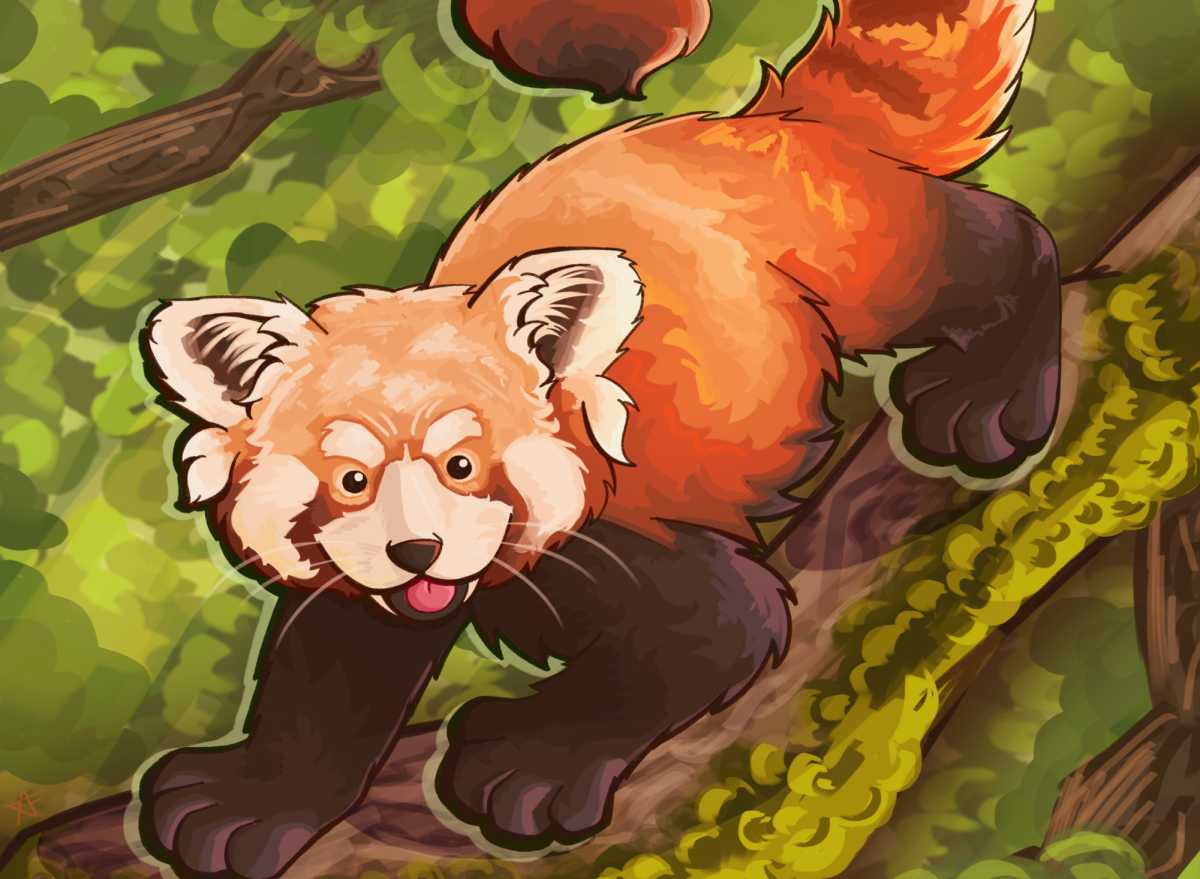
The furry bamboo eater of the east: the red panda.
The red panda is native to southwestern China, specifically the Himalayan mountain ranges such as the Sivalkin and Tibetan belts. The abundance of bamboo in China’s temperate forests serves as both a fuel source and a shelter, making it crucial for this small mammal’s survival. These forests provide more than just food, they also offer protection from predators and a place to rest high in the trees. Red pandas spend much of their time off the ground, moving through branches with ease. Because they rely so heavily on this specific environment, any damage to it has a direct impact on their survival.
The red panda is a well-known figure due to its striking characteristics, including reddish-brown fur, ringed tail and white facial markings, making it easy to recognize. As a result of these unique characteristics, the little mammal is not a stranger to social media fame. The red panda has gone viral on various platforms for its unique habits, such as licking food before chewing, attempting (and failing) to be intimidating by standing on hind legs and intriguing people with its eye-catching physical traits. While these moments are often seen as funny or cute, they are simply part of how the animal naturally behaves. Its shy nature continues to make it more interesting, since it is not commonly seen in the wild.
Despite its popularity online, this animal is still closely tied to its natural habitat. It primarily eats bamboo, even though its digestive system is more similar to that of a carnivore, meaning it has to consume large amounts each day to maintain its energy. Because of this, it depends heavily on healthy bamboo forests to survive. Additionally, it is a generally shy and solitary animal, often staying in the trees and avoiding human interaction, which contributes to how rarely it is seen in the wild.
Regardless of its adorableness, the red panda is not immune to the dangers many eastern Asian animals are enduring. Over the past two decades, many species have suffered severe population declines, with the animal population as a whole decreasing by roughly 40%. As of April 2026, only 2,500 to 10,000 red oandas remain independent of humans in their natural habitats. This is fueled by rising deforestation, poaching and habitat fragmentation. As human activity continues to expand, the forests they depend on become smaller and more divided, making survival more difficult.
To conserve and protect the endangered species, the Red Panda Network actively works with neighboring communities and authorities to ensure these fuzzy creatures have a safe environment. Their efforts include protecting forests, reducing poaching and spreading awareness about the species. While this work has helped, the red panda is still at risk.
Even though it’s small, this animal still matters and its survival depends on the health of its environment.
In the end, the red panda is a unique species that depends on both its environment and ongoing conservation efforts to stay protected. It continues to be an important and recognizable part of the natural world.