COVID-19 (COVID) halted the Foothill Tech cross country (XC) program’s momentum after the 2019 California State Championships, the most recent state title in Foothill Tech XC. However, despite this setback, the program has experienced a rapid rebuild in their performances — in 2021, the first XC season to return to California Interscholastic Federation (CIF) competition after COVID, Foothill Tech failed to advance to state, compared to the 2025 season, where the Foothill Tech boys team placed third in the fastest division four state race ever, with a fifth-fastest team time performance for division-four state. Both the three-mile and five-kilometer school records were also set in the 2025 XC season.
But these strides in both team and individual times were far from a Foothill Tech specific occurrence, illustrated by the Foothill Tech boys team placing third in state three years in a row, despite over three minutes of growth in their team time across those years. This occurrence of increasing times since COVID has become a prolific reality in both XC and track and field (TF) in all levels of scholastic and professional competition — a phenomenon labeled “trackflation”.
Trackflation, and the general rapid growth of all running times since 2021, has presented itself in the form of both unprecedented team performances and new levels of individual talent. Coming out of COVID, current professional athlete Hobbs Kesler helped begin this trend by exploding onto the 2021 TF scene with an incredible 3:34 1500m performance. This time was faster than the NCAA record at that time, which Kessler surpassed despite being a senior in high school. Other high school athletes, notably Quincy Wilson and Sam Ruthe, have shattered age group records, world U18 and U20 records, competed in professional races and qualified for Olympic and World Track and Field Championships trials since 2021.
Not to be outdone, XC has seen recent national records set such as in the three mile distance, which Owen Powell completed in 13:30 in the 2024 Woodbridge sweepstakes race. A series of key course records during the 2025 XC season have also fallen, including the 14:10 performance at Mt San Antonio College (Mt Sac) run by Yohanes Van Meerten and the record shattering races at Woodward Park, home of the state course, run by Summer Wilson and Jackson Spencer in 16:20 and 14:16.
Beyond the growth of the best of the best, general times have similarly improved across XC and TF, and the marks required to be competitive in state and national competitions have steadily risen.
But what caused this spike in performances? The sport of athletics as a whole has seen revolutions in shoe technology, standardized training techniques and superior nutrition and sleep habits among athletes.
Technology, primarily in the growth of super shoes — shoes defined by lightweight foam and carbon fiber plates to maximize energy return and running efficiency — has revolutionized all aspects of distance running performance. Since the Nike Vaporfly 4 percent dropped in 2016, super shoes have presented themselves in the professional scene, with the top three finishers in the Rio de Janeiro Olympics marathon wearing the Vaporfly 4 percent. After COVID, these shoes became ever more common and now dominate high school competitions.
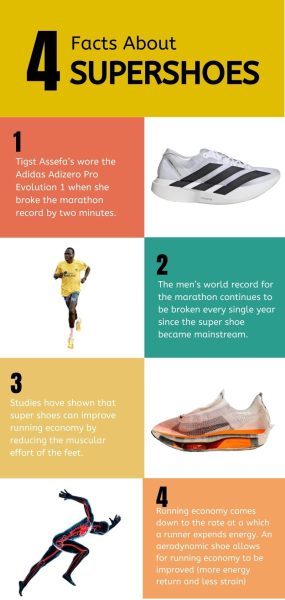
“The shoes are definitely having an impact … Depending on who you’re talking to, it’s close to a three to five percent improvement,” Rio Mesa High School Coach Ken Reeves said.
Another core change in both XC and TF is the methodology of coaching and the standardization of training. National clinics and more public and shared information about the sport have helped give coaches a platform to learn from each other and have also helped iron out a core training technique widely used today: lactic threshold training. This form of training, involving long sustained efforts at the level where lactic acid, a fuel source used during high-intensity exercise, can be produced but not build up, has been prevalent in general form for decades but has been better understood and standardized for high school competition since COVID.
“There still are certainly some variants … but I think, as a whole, the trend is kids are running more miles and more threshold volume and I think it’s definitely good for high school performances,” Jonah Billings, a Western Washington University XC and TF captain, said.
“COVID changed how a lot of people trained, especially in the years when there was no organized practice, but you had guys training like pros … pushing 4:20 isn’t fast anymore,” Reeves said.
An important part of improvement in any sport, particularly athletics, is just as much in the unmeasurable mental and social parts of the sport as it is in the technology and training aspects. When performance trends up, other runners have to pay more attention to small improvements, including nutrition and sleep, out of necessity and in an effort to keep up. This has created a snowball effect where faster times create higher requirements to be competitive and thus a need for more faster athletes.
“You’re seeing a lot more disciplined high school kids who are taking care of their bodies a lot better … and then you’re also seeing some steps forward in nutrition as well,” Billings said.
“I think there’s a little bit better quality of an athlete … In the old days if you had three good guys you were good, now you need six or seven [to keep up],” Reeves said.
Regardless of reason, and how much each part of the post COVID running boom has affected performances, this era undeniably represents a period of large change and the revolutionization of distance running sports. Standardized training, shoe technology, more spaced out racing schedules and more athletes that consistently work on the little things all play their role in contributing to this movement in athletics.
“I think that above all of that is a rising tide raises all ships … You’ve got kids running fast and you’ve got deep fields at these big invitational meets and when you bring all those fast kids together who have been sleeping more, eating better and training better and then you put them in a race against each other … everyone’s going to run faster.” Billings said.
Trackflation and unprecedented times still spring up across high school athletes today. Sprint times have felt this shift as well and athletes both before and after high school are feeling the continuing growth of the sport. The question now is: how much faster can athletes get, and at what point are times too fast to keep growing?