


Piercing screams echoed through the night at Foothill Technology High School (Foothill Tech) as the Drama Department presented the play Murder on the Orient Express, along with an immersive dinner service catered by Presto Pasta, on Nov. 14, 15, 21, and 22. Two casts graced the stage, with Cast Agatha performing on Nov. 14 and 22 and Cast Christie performing on Nov. 15 and 21. Adapted from Agatha Christie’s classic mystery novel of the same title by playwright and author Ken Ludwig, the story features detective Hercule Poirot as he investigates the murder of businessman Samuel Ratchett, who was found stabbed to death in his compartment. Eight passengers on the Orient Express tell their sides of the tale as Poirot, played by Troy Braley ‘26 in Cast Agatha and Scarlett Palmieri ‘27 in Cast Christie, seeks out the convict.
The play opens with a flashback to one of Poirot’s previous cases, featuring a young American girl, Daisy Armstrong, who is kidnapped from her family home and later found dead in the woods. Poirot still ponders over this case, as the killer escaped and left Daisy’s family in shambles. After another similarly vexing case, Poirot decides to vacation in Istanbul to clear his mind, bringing the audience to the present story.
Istanbul is home to the famed Orient Express, owned by Poirot’s good friend Monsieur Bouc, played by Brooklyn Martinez ‘29 in Cast Agatha and James Simpson ‘29 in Cast Christie. As the passengers board this luxurious train for the three-day journey to Paris, audience members are introduced to the colorful cast of characters that will act as the suspects in this story.
Colonel James Arbuthnot and Mary Debenham, a secretive pair, are the first to be introduced, followed by the extroverted and flirty Helen Hubbard, an American traveler. Exiled Russian Princess Natalia Dragomiroff is accompanied by Swedish nun Greta Ohlsson, and the group is rounded out by Countess Andrenyi, a trained doctor who came into riches after marrying the Count, yet still entertains Poirot’s interest.

Members of this cast mentioned some of the highs and lows involved in putting the production together.
“The line memorization has been awful. It’s horrible. So many lines, holy moly. But really, that’s the only down. I think this has been a great show, and it’s my favorite show I’ve been in so far,” Braley said.
“Sometimes we have people not showing up or missing cues, and that can be difficult, but we all work through it,” August Banando ‘27, who played the role of Colonel Arbuthnot in Cast Agatha, said.
While the lengthy lines and cues may have presented some memorization difficulties, the cast also reflected on the positives of the production process.
“I think a lot of the highs were just being in the environment around everyone, especially with such a great group of people. I think we got a really good group of people this year who came into the drama, and I don’t think it would have been the same without them,” Grace Monaghan ‘27, who played the role of Greta Ohlsson in Cast Christie, said.
The Drama Department made a few modifications to the staging of the show to further immerse the audience in the story, making use of the lighting and sound effects at their disposal.
“I always like to set a challenge for each show, and I wanted to add these flashbacks to the script that are not usually staged, and they rose to that challenge of working with that. My lighting crew did an amazing job with our new lights that we bought this year, and the sound crew did amazing,” Kevin Becker, the Drama Department teacher and director of the show, said.
The plot of the show is thickened by the arrival of businessman Samuel Ratchett and his assistant Hector MacQueen, as it is revealed that Ratchett is being threatened through a series of mysterious letters. Ratchett attempts to recruit Poirot to work the case of these threats, but Poirot refuses, despite the offer of thousands of dollars in payment or physical harm if he decides not to assist.
A surprising twist occurs as Ratchett is found dead in his compartment the following morning, and suddenly every passenger is a suspect for murder. While everyone has an alibi during the supposed time of death, Poirot suspects that there is more to the story, and begins to conduct the well-known interrogations and evidence collections he is famous for.
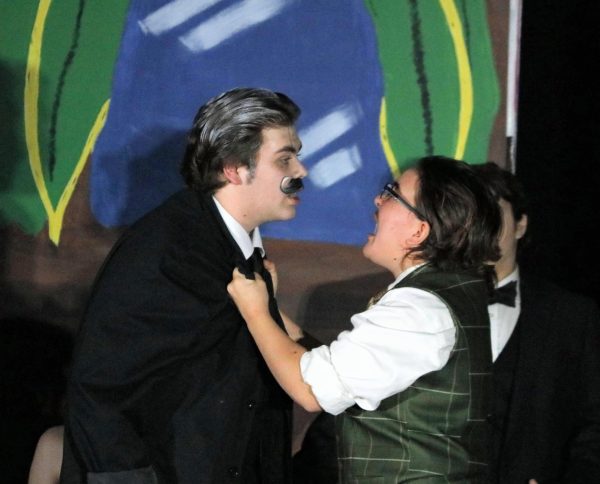
When investigating Ratchett’s mysterious murder, Poirot finds a few clues that guide his later investigations, including eight stab marks in Ratchett’s chest, with five being strong and the other three weak, an open window, but no footprints, a handkerchief embroidered with the letter ‘H’, wine smelling of almonds, leading to the conclusion of cyanide poisoning, a pocketwatch smashed at the time 1:15 a.m. and a note, reading, “Remember little Daisy Armstrong.”
Using these clues, along with the knowledge gained through interviews and observation, Poirot arrives at the conclusion of the case. He assembles the suspects for the dramatic reveal, where he questions the identities of not one passenger, but every single one of them, including the conductor, Michel. This leads to the revelation that all of the passengers on the train were involved in the murder, an act of vengeance for Daisy Armstrong, as Ratchett turns out to be her escaped killer, Bruno Cassetti. The passengers from all corners of the world are indeed members of a single group, consisting of the family and friends of Daisy Armstrong, seeking justice for the young life that ended too soon.
“Murder on the Orient Express” not only tells a twisting, complex story, but also questions what justice truly is. While the case is now solved, Poirot faces an even deeper dilemma — does he turn in the passengers to the police, where they will be punished for what they saw as a just act, or will he lie to the authorities, challenging his belief in honesty and truth to protect the family of an innocent girl? Although Poirot chooses the latter option, at the end of the play, he reveals that the case still keeps him up at night with him questioning whether he made the right decision, prompting the audience to confront their beliefs regarding moral rights and wrongs.


















kamir bouchareb st • Dec 11, 2025 at 11:52 am
thanks for this