




It’s nine a.m. on a Monday. You’re sitting in front of your school-issued Chromebook, its screen within which your sixth-grade language arts teacher has been reduced to a tiny pixelated box, her voice reaching tinny and a little unreal in your earbuds.
This is the reality that thousands of students across the nation were forced to face when the virus known as SARS-CoV-2 swept through millions of lives without paying heed to the unprecedented societal upheaval it was leaving in its wake.
Just one of the virus’s impacts was on the education system. Here in the Ventura Unified School District, administrators scrambled to extricate whole classrooms from in-person to online platforms like Edgenuity, Canvas and Zoom video calls.
However, the experiences of all involved during the mandated distance learning period, extending from March 2020 to January 2021, were overwhelmingly negative.
Donovan Yalinkatian ‘26, a student at Foothill Tech, was a sixth grader when the pandemic hit. Just like many other young students, when left to his own devices at home, his attention wandered more often than not.
“I remember I was in Mr. Mayer’s class. I woke up and got right on the Zoom call — I didn’t have my camera on, of course, because not a lot of people did. I didn’t feel like doing [class] that day, so I started to play video games, and I was distracted from what he was teaching because it was ancient Mesopotamian stuff, and I was clearly more interested in Minecraft. And then, all of a sudden, I hear, ‘Donovan, hello, are you still there?’ And I’m the last one in the Zoom call with him, and I just said, ‘Oh, I had to use the restroom,’” Yalinkatian said.
Motivation for school plummeted during this time, with the Pew Research Center sharing that 16 percent of teens are worried that they have fallen behind in school due to the pandemic, with 28 percent of parents saying the same about their child.
And according to the National Center for Education Statistics, “The COVID-19 pandemic led to a historic decline (2.7 percent) in public school enrollment in fall 2020.”
Furthermore, teachers found it more difficult to keep students on track.
Anderson explained, “The challenge was, how do you keep them engaged on the other side if they’re not even there? I’m creating all of these ways to try to engage [students], but the camera’s not on, they’re asleep.”
Yalinkatian added on, saying, “Me and a number of other people that I know were not very motivated when it was on our own accord to learn. It’s not very engaging, especially for a seventh grader.”
You probably can’t say that you or a student that you know has never consulted Artificial Intelligence on a tough math problem or used it to check grammar, but there is a difference between using AI as a tool and having it replace your thought process.
An increasing number of students in just the past few years have turned to AI to do their homework entirely, rather than utilize it to guide them through difficult problems.
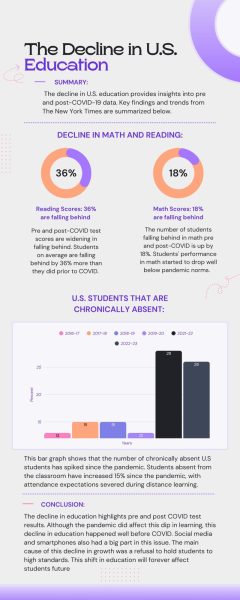
Research from the College Board shows that between January and May 2025, the percentage of students who admitted to using generative AI tools for schoolwork had increased from 79 percent to 84 percent; in May 2025, ChatGPT, an advanced generative AI chatbot, was reported to be used by 69 percent of high school students for homework and school assignments.
While students use AI to revise their writing, research various topics or find sources, they may also use it to do their schoolwork before they even attempt it themselves. Not only does this appear as though students are not respecting the time teachers put into creating assignments, but these students are also ultimately not gaining any knowledge out of it.
Hayden Jacobson ‘29 realizes that students who use AI on their assignments are not receiving the education that they intended to come to school for.
“Using AI won’t help us learn anything. It’s just helping us do the work and not learn. So the next time we have the same [problem], we’re not gonna know how to do it. We’re just gonna use AI and cheat,” Jacobson said.
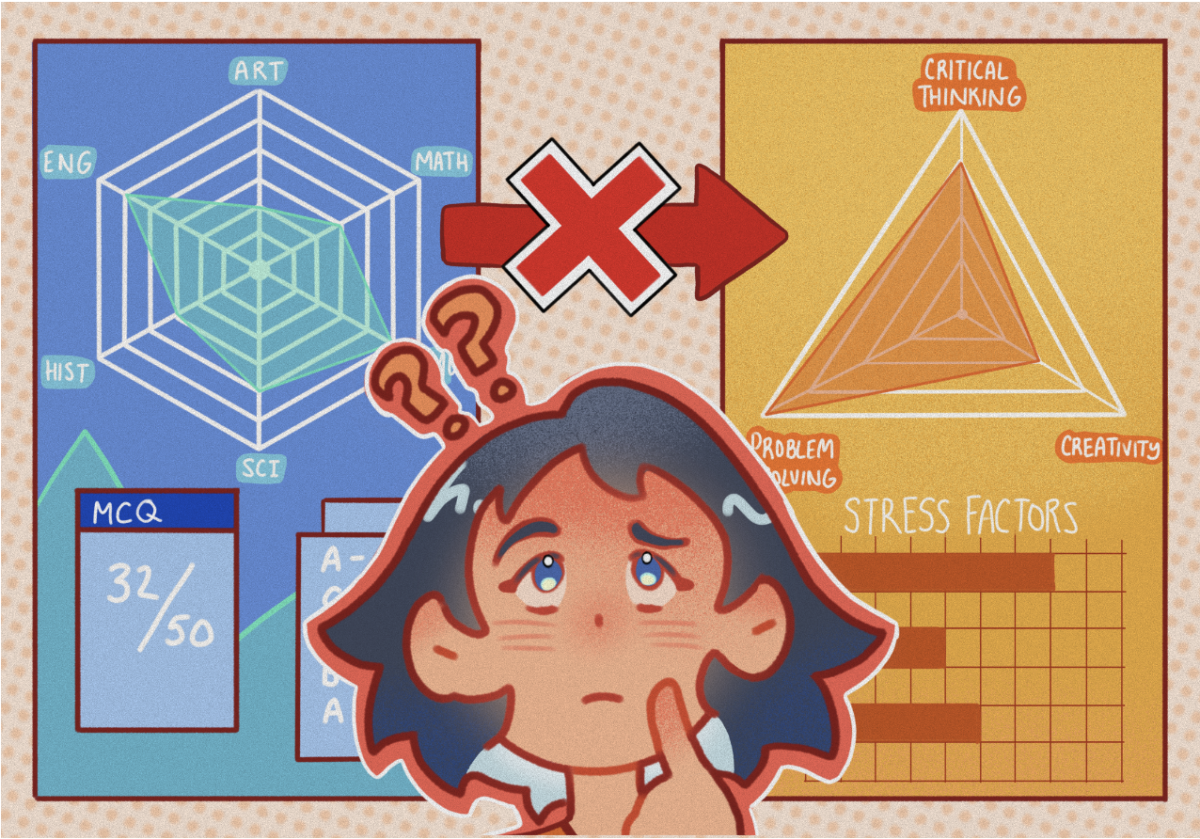
Using AI as a substitute for thinking over schoolwork creates future dilemmas in which prior education is needed. Not only is it a first resort to replacing a student’s basic interpretation, but it also limits them from engaging in critical thinking and being able to reflect on complex ideas. It becomes an even bigger issue when used for cheating and plagiarism.
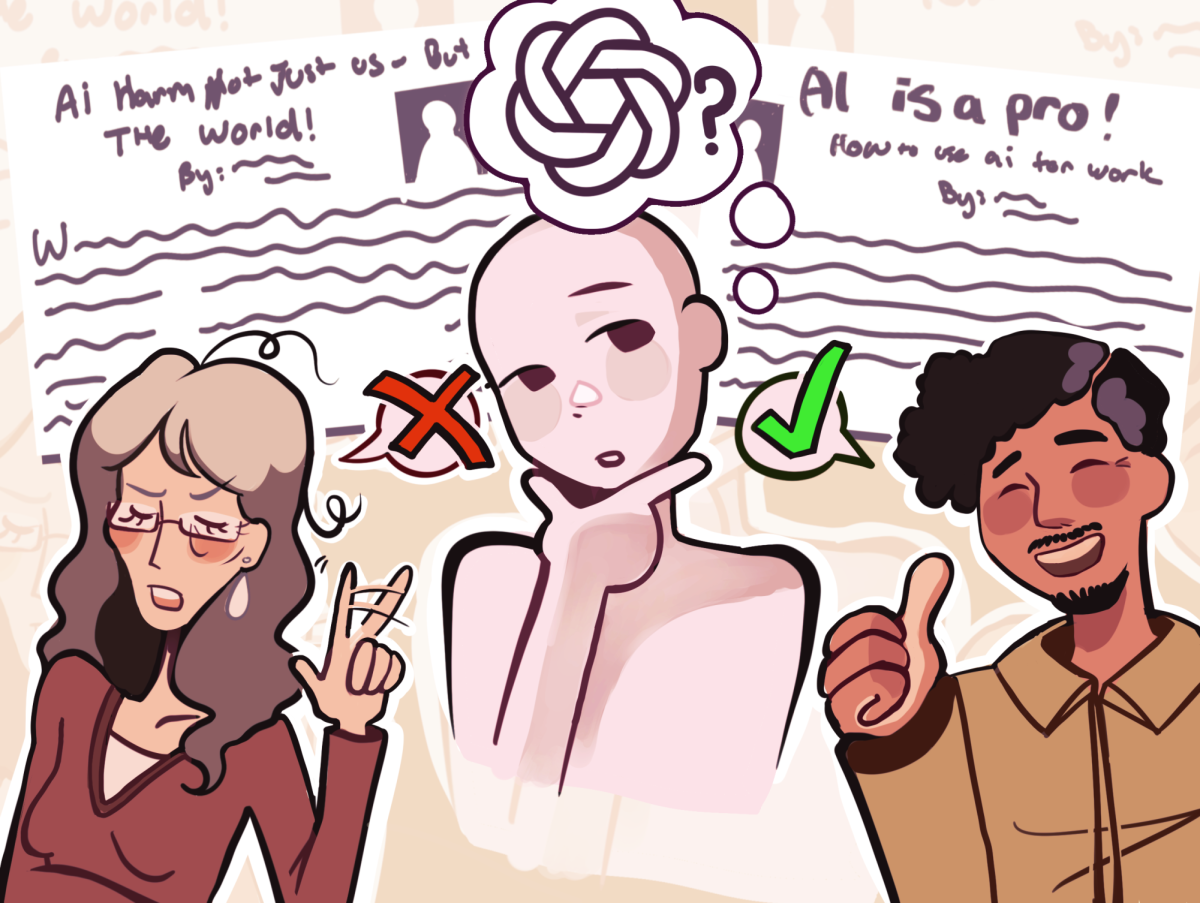
According to Pew Research Center, 29 percent of teenagers ages 13 to 17 think it is acceptable to use ChatGPT to solve math problems, 18 percent think that it is acceptable to use it to write essays and 15 percent to 21 percent are unsure of whether or not it is acceptable to use ChatGPT for these tasks.
Sometimes it seems that high school students put more effort into trying to find a way around actually doing assignments than ever attempting them in the first place.
“[Students] thought more about finding a shortcut to get to the answer instead of using critical thinking to get themselves in tune with what they’re doing and I think that might have planted the seed for how much of a problem AI is today … I think the biggest issue is that there should be a greater movement to adapt all these tools because people are going to use them regardless,” Yalinkatian said.
While there are limits to how successful adults can be when attempting to reverse the effects AI has on education, maybe motivation should become a bigger focus of students’ education, rather than continuing to watch performance decrease as the years go by without coming up with a solution.
“[Students] have to have some out-of-the-box thinking in order to problem solve because the problems are always going to come … and with AI, I think that makes it too easy where people aren’t doing that anymore at the cost of ‘I want that A,’ rather than, ‘I want to work hard in order to get that A because in the long run this is what’s going to benefit me,’” Anderson said.
Anderson explained that adults are there to help students learn; however, students still have the obligation to meet halfway. Teachers will answer students’ questions— but first, the question has to be asked. The issue is discovering what motivates an individual student to want to learn and to want to seek the answer to their question.
“We’re starting to see students that are expected to be at grade level, but they’re not at grade level … People feel less successful and then with that comes a drop in passion, so that’s the part that’s sad to me, the lack of initiative. Of, ‘how do I get to the next step?’ ‘How do I bridge the gap?’ The schools have a responsibility to help bridge the gap, but so does the individual. It really needs to come on both sides,” Anderson said.
Students who fall behind at school might not see a reason to continue aiming for their goals because they do not see a chance of climbing back up to the level that they want to be at. So, not only has AI led students to avoid analytical situations and drop below their academic level by not attempting basic assignments, but it has also brought a significant lack of enthusiasm and drive for one’s education.

Whether you’re in a fit of procrastination or a state of pure boredom, your natural instinct is probably to open your phone and browse social media platforms, consume short-form content or open the video game you have been craving for hours at school.
A National Institute of Health study shows that middle school students who spend an average of five to six hours in front of a screen daily on video games or surfing the internet, presented lower grades in mathematics, reading and physical education.
While the possibilities of the internet are endless and some forms of usage, such as educational videos and informational articles, may be beneficial to a student’s academic performance, most students would rather spend their time on TikTok or a video game.
Anderson has observed the effects of screen time on her own students.
“It’s so easy to get distracted when you’re doom-scrolling all the time or when you’re going on to YouTube videos and watching somebody else play video games on the screen. It’s just like, if you’re gonna be [watching others play], why not just play video games yourself?” Anderson said.
Among the many students who find themselves distracted by the screen, Yalinkatian is no exception to the temptations of screen usage.
“I think I could say I’m affected by [screen time] honestly because like so many people, myself included, would much rather, like, get on TikTok or play a video game than do schoolwork,” Yalinkatian said.
He also believes that screen time takes away from the general value of creativity and activities outside of school.
“I’d say it impacts education with how much time people are spending on that instead of other things. I think especially in the course of how many hobbies that people used to have, if you’re not exploring that, like creative side by doing, I don’t know, drawing, painting, or people who make music, play guitar, you’re kind of limiting yourself in the sense of how many skills you’re willing to learn,” Yalinkatian said.
While screen time can take away from productivity in school and feed into procrastination, content within social media platforms can negatively alter a user’s mental health. For students, time and energy spent on worrying about what others see online and how they’re perceived among their peers is siphoned away from performance in school.
“There’s the whole mental health aspect of being liked or not liked or your persona and what you put out there, all of that weighs heavily on not just somebody’s mental health but also their huge distractors and whether or not you can have a phone in a classroom,” Anderson said.






CinaRuge • Feb 7, 2026 at 6:00 pm
Hey! It’s Cina! Guys, I don’t know what to say, but we have to face this together-school next year will totally be different.. The US Board Of Education is facing its biggest problem and we are losing money rapidly for education in the US. I live in Alaska and next year, the sports in my school will be tragically cut. I will only have 6 periods of school and no electives. All after-school activities and sports will be cut. We actually don’t even know if there will be any school at all in my state. Then maybe I’ll be homeschooled even before I finish high school. 😭 WE have to face this! Anybody else from Alaska? We will see what happens.
Stay tuned for any bad or good news
Cina