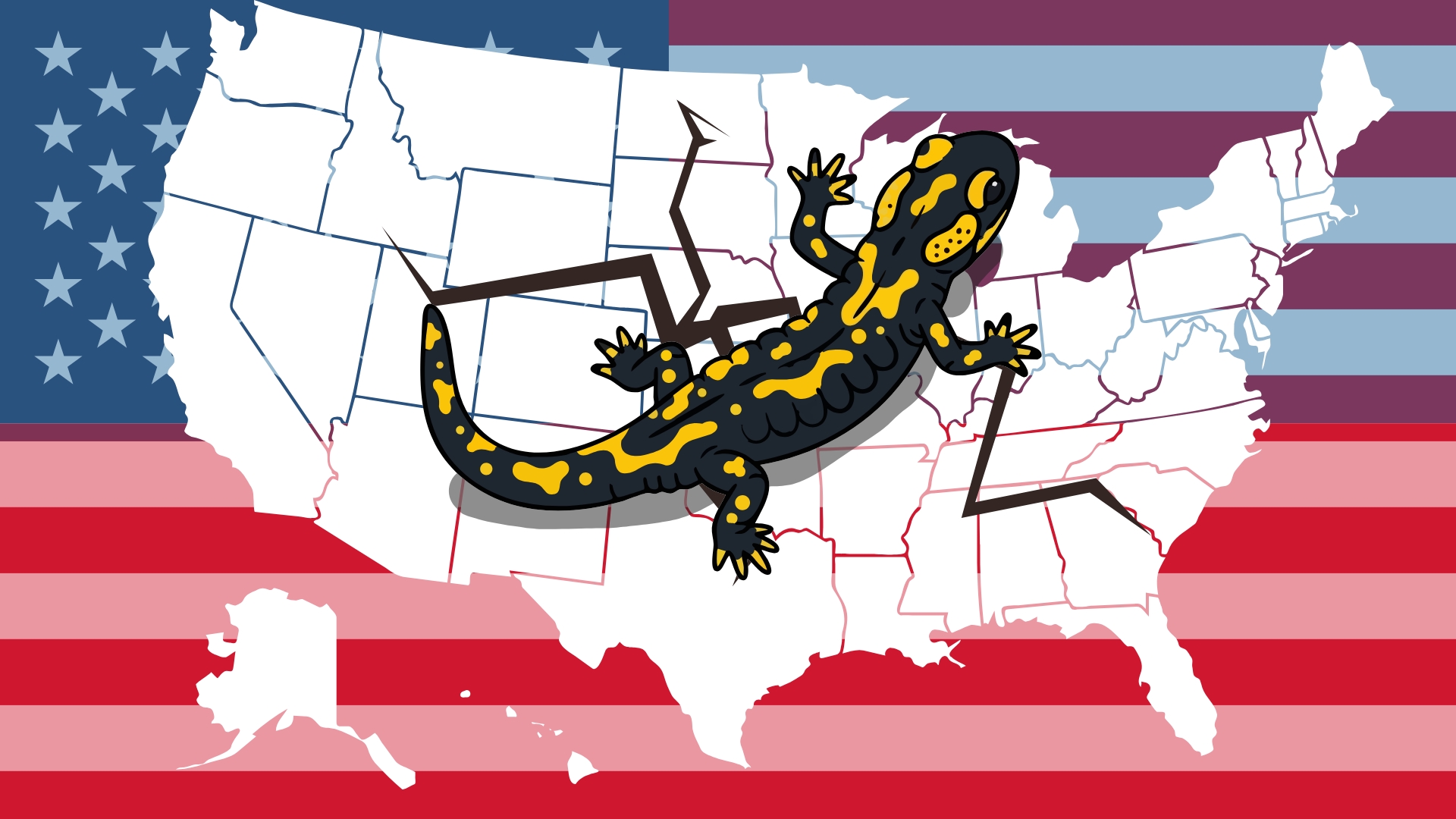

On March 26, 1812, the Boston Gazette proclaimed that a “great winged salamander” had made its home in the Boston area, which would forever change the future of representative democracy in the United States — and abroad. The salamander was, in fact, not some great monster of myth, but a satirical representation of a newly drawn Massachusetts congressional district that disproportionately favored voters of Democratic-Republican senators.
This strange congressional border helped cause the Massachusetts state senate to remain in the hands of the Democratic Republican party in the election of 1820. It also created the name for any time a government in power establishes district boundaries for its benefit: the portmanteau of the then-Governor of Massachusetts’ name, Elbridge Gerry, and his salamander-like creation: gerrymandering.

Oxford Languages defines gerrmandering as the “manipulation of an electoral constituency’s boundaries to favor one party or class,” a maneuver that has been utilized in multiple ways to ensure a target voter group gains or loses representative power. Some consequences of gerrymandering include misrepresenting communities or cities by splitting them among district boundaries or giving one racial demographic more political representation.
The precedent for this rewriting of boundaries in the United States occurs every 10 years with the national census, where states redraw congressional district borders to reflect population changes. When the decade comes to a close, 31 state legislatures determine their own congressional boundaries, while other states have their boundaries drawn by independent or appointed commissions.
Each of these districts must include equal population representation and avoid racial discrimination when electing one member of the House of Representatives. State supreme courts and the Supreme Court of the United States (SCOTUS) have made many rulings on individual state congressional maps in the 21st century when their fairness came under question.
In 2011, the Republican legislature redrew Wisconsin State Assembly districts based on 2010 census data, a redrawing that was challenged as favoring Republican voters after 60.6 percent of seats in the state Assembly went to Republican representatives despite Republican voters representing only 48.6 percent of the statewide vote. This case, Gill v. Whitford, coincided with another case, Rucho v. Common Cause, where a North Carolina congressional district map was challenged as violating the First Amendment, the Equal Protection Clause, and Article One, sections two and three of the U.S. Constitution.
Both of these challenges were accepted in state courts but remanded by SCOTUS and dismissed. SCOTUS further decided in its ruling on Rucho v. Common Cause that federal courts could not intervene in cases of gerrymandering that favor a political party, leaving those decisions up to state courts and legislatures.
Today in the United States, where state legislatures have final say over partisan gerrymandering, the topic is present in discussions on fair representation and even in the political scene of the House and Senate. In the 2024 elections for members of the House of Representatives, out of the 435 congressional districts, only 37 districts were won by less than five percent. Out of that, only 11 districts switched parties. This begs the question of the extent of gerrymandering if less than ten percent of districts are contested.
Gerrymandering has been combated in states by minimizing bias by using independent commissions to decide their congressional districts. One such example is California Citizens Redistricting Commission (CCRC), an organization that has no hand in current mid-decade changes to California’s congressional district border changes under Proposition 50 (Prop. 50). Now more than ever, where state legislatures renew their influence over their congressional districts, gerrymandering remains a threat to fair representative democracy and its future hangs in the balance awaiting the first citizen vote to change congressional borders in United States history with Prop. 50.